New LINC Grants aim to tackle unmet medical need
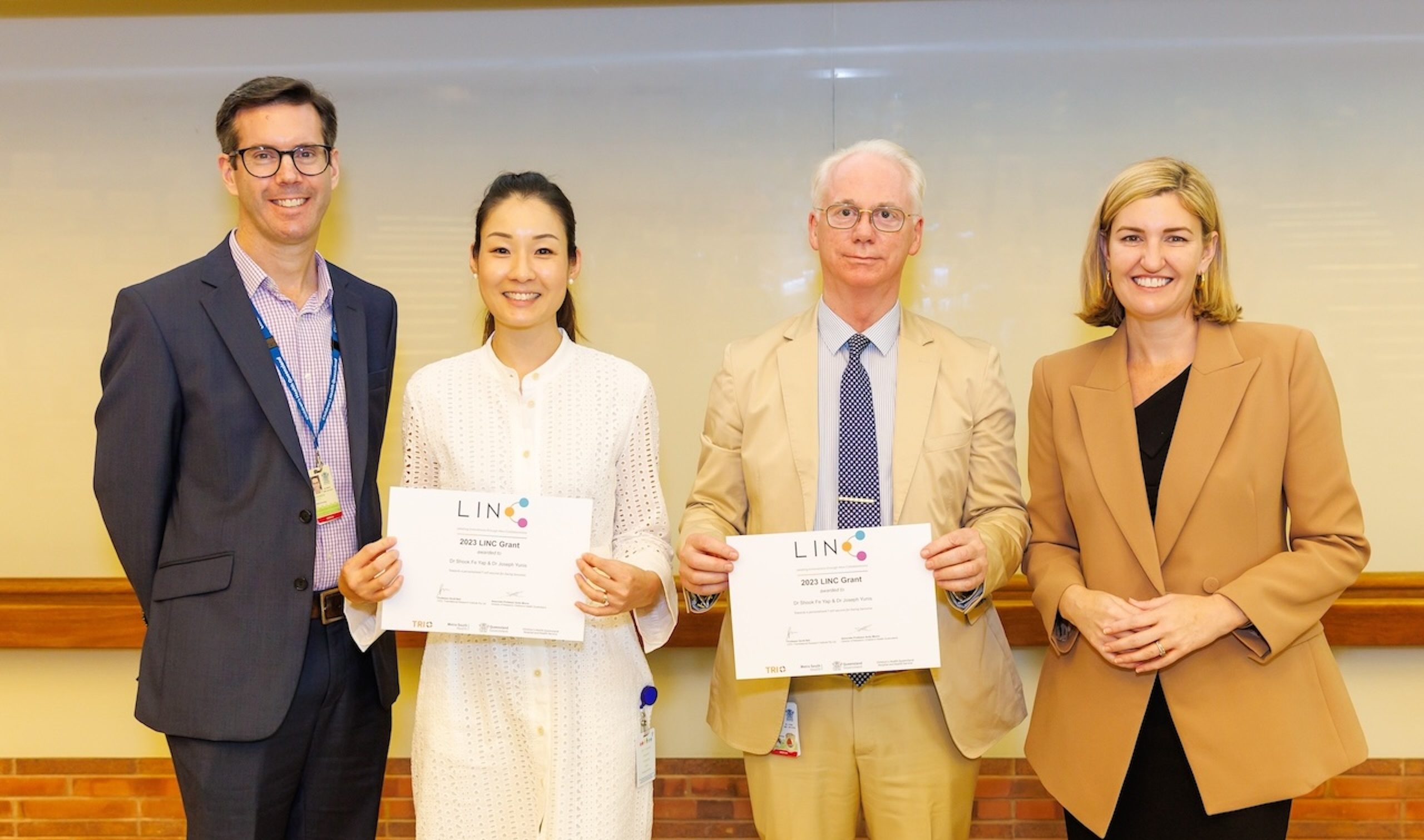
Each project will receive $50,000 in seed funding from TRI and clinical partners Metro South Health (MSH) and Children’s Health Queensland (CHQ), bringing the 2023 LINC funding pool to $350,000.
The Queensland Minister for Health, Mental Health and Ambulance Services, Shannon Fentiman, who awarded the grants, said she was impressed with the high calibre of medical research happening within TRI.
“It was wonderful to meet the researchers within the Translational Research Institute and hear first-hand how their collaborations with clinicians have the potential to transform healthcare,” Minister Fentiman said.
“We know how important it is to support research as it continually brings us closer to new treatments or medical devices capable of improving patient outcomes.
“The talented researchers from TRI’s partner institutions, together with clinicians at PAH or CHQ, are doing exceptional work to solve health challenges across a variety of specialities including children’s immunity and cancer.
“The Queensland Government is strongly committed to investing in research that tackles hard-to-solve diseases facing the community and Queensland Health, as a founding shareholder of TRI since 2012, is dedicated to advancing that ambition.”
Now in its third year, the LINC scheme provides opportunities for early and mid-career researchers and fosters collaboration between researchers and clinicians.
TRI CEO Professor Scott Bell said the LINC scheme was built on the foundations of translational medical research, which bridges the gap between scientific discoveries at the lab benchtop, to their application at the patient’s bedside.
“These new projects all address areas of unmet medical need, where we know more research is vital. The scheme encourages innovation and collaborations, furthering our ability to make an impactful contribution to the community.”
“Over the last three years, more than $1 million had been awarded in medical innovation grants through the LINC scheme.”
One of the seven successful projects is being led by UQ’s Dr Lauren Aoude and Metro South Health gastrointestinal surgeon Dr Adam Frankel, who are investigating treatment options for a type of oesophageal cancer with high mortality and few treatment options.
TRI Executive Director, Research and Clinical Translation, Associate Professor Helen Benham, said the LINC scheme provided an important role in delivering clinically relevant innovation within the sector.
“This scheme helps support new ideas that are reflective of the evolving needs of the patient,” Associate Professor Benham said.
“This approach means medical advancements are clinically relevant, while being based on the latest scientific discoveries.”
The latest round supports TRI based researchers to partner with clinicians from Metro South Health or Children’s Health Queensland.
Metro South Research Executive Director, Professor John Upham, said the latest LINC grants would provide a new round of clinicians with the opportunity to solve pressing medical challenges.
“Clinicians offer invaluable insights into the practical challenges and unmet needs of patients and can help drive research that will make a direct impact.”
Children’s Health Queensland Director of Research, Associate Professor Andy Moore, said the LINC grants helped to support essential research and innovation in children’s health.
“These grants give our paediatric clinicians an opportunity to take what they’re seeing at the bedside of a sick child, and work with a researcher at the bench to develop a solution.”
The seven successful projects are:
Adults
- Preventing blood stream Infection by removing E. coli’s protective cloak. Lead scientist: UQ’s Michelle Chamoun. Lead clinician: MSH’s Burcu Isler
- Development of novel drugs for the prevention and treatment of skin cancer in immunosuppressed organ transplant recipients. Lead scientist: UQ’s Ming Tang. Lead clinician: MSH’s Samantha Ng
- Localised immune checkpoint therapy for cutaneous head and neck cancer. Lead scientist: UQ’s Amelia Soderholm. Lead clinician: MSH’s Catherine Barnet
- Establishment of patient-derived 3D organoids to accelerate personalised treatment of oesophageal cancer. Lead scientist: UQ’s Lauren Aoude. Lead clinician: MSH’s Adam Frankel
- A novel approach to engineer personalized vaccines to prevent cutaneous Squamous Cell Carcinoma. Lead scientist: UQ’s Yang Yang. Lead clinician: MSH’s Rahul Ladwa.
Children
- Genomics of paediatric inborn errors of immunity. Lead scientist: UQ’s Tatiane Yanes. Lead clinician: CHQ’s Peter McNaughton
- Towards a personalised T cell vaccine for Ewing Sarcoma. Lead scientist: UQ’s Joseph Yunis. Lead clinician: CHQ’s Shook Fe Yap.