Login
Contact

Explore

Explore

About
  • People and Partners
  • TRI Building
  • Reconciliation Action Plan
  • Strategic Plan
  • TRI Foundation
  • Careers
Research
  • Collaborate
  • Discovery
  • Translate
  • Engage
  • Research Areas
Clinical
  • Translational Trials
  • Clinical Research Facility
  • TRI at Children’s
Industry
  • TRI Incubator
  • The Precinct
  • Residents
Manufacture
  • New cGMP Facility
Facilities
  • Cleanroom
  • Flow Cytometry
  • Histology
  • Microscopy
  • Proteomics
  • Preclinical Imaging
  • Biological Research
  • Gnotobiotics
  • Human Immune Model
Get Involved
  • Health Consumers
  • SPARQ-ed
Resources
  • News
  • Events
  • Case Studies
  • Grants and Funding
  • Education and Training
+61 7 3443 7000info@tri.edu.au37 Kent Street, Woolloongabba QLD 4102 Australia

Acknowledgement of Country

TRI acknowledges the traditional custodians of the land we are on today, the Turrbal and Jagera people and we recognise their continuing connection to land, waters and community. We pay deep respect to them and their cultures; and to Elders past, present and emerging.

© Translational Research Institute Pty Ltd atf the Translational Research Institute Trust|ABN: 58 155 991 662
Privacy policy|Terms of Use|Contact Us
TRI · About · Reconciliation Action Plan

Reconciliation Action Plan

TRI StoryPeople and PartnersTRI BuildingReconciliation Action PlanStrategic PlanTRI FoundationCareers

Culturally-led and informed research

TRI is committed to building connections between the Indigenous and non-Indigenous voices working together within our OneTRI ecosystem.  We respect the need for traditional knowledge to underpin the contemporary technology behind all aspects of translational research. When these are combined, culturally led and informed research enriches and strengthens our reconciliation story.

[Aboriginal and Torres Strait Islander peoples should be aware that this website may contain images or names of people who have passed away.]

A commitment to reconciliation

Let their voices guide us and connect us to a healthier future, designed by Wakka Wakka man David Williams, tells the story of TRI’s reconciliation journey.
A commitment to reconciliation

Let their voices guide us and connect us to a healthier future, designed by Wakka Wakka man David Williams, tells the story of TRI’s reconciliation journey.

Our Reconciliation Action Plan

Our Reconciliation Action Plan represents TRIs commitment to creating more equitable outcomes for all Australians.

TRI had a vision to create a diverse and inclusive workforce, respectful of differences and recognising that reconciliation forms part of our past and future.

TRI has developed this vision into an organisation embracing reconciliation as a whole, with our senior leadership team embedding the Reconciliation Action Plan as a strategic priority.

A Story of Commitment

The TRI Reconciliation Action Plan artwork: Let their voices guide us and connect us to a healthier future tells the story of our reconciliation journey. A story that started with collaboration. A story built on the strength of its relationships. A story whose future depends on connection.

Our Reconciliation Goals

Through partnerships, we aim to create a culture and legacy which promotes new opportunities and positive outcomes for Aboriginal and Torres Strait Islander peoples.

  • Community groups – partnering in research, leaving lasting legacies.
  • Working with our Supply Nation certified businesses and support services.
  • Creating links and opportunities for Aboriginal and Torres Strait Islander university students through Career Trackers, The University of Queensland and the Frazer Institute.
SPARQ-ed

DEADLY Science: Supporting STEM pathways for indigenous students

Aboriginal and Torres Strait Islander high school students joined us to conduct a science experiment at the SPARQ-ed laboratory and classroom at TRI during National Science Week. Following the hands-on experience, UQ ATSIS outlined the supports they provide for our next generation of scientists and researchers – including assistance with UQ admission and entry pathways, transition to University life, scholarships and learning support and advice.

National Science Week

SPARQ-ed

DEADLY Science: Supporting STEM pathways for indigenous students

Aboriginal and Torres Strait Islander high school students joined us to conduct a science experiment at the SPARQ-ed laboratory and classroom at TRI during National Science Week. Following the hands-on experience, UQ ATSIS outlined the supports they provide for our next generation of scientists and researchers – including assistance with UQ admission and entry pathways, transition to University life, scholarships and learning support and advice.

National Science Week

Case Study

Genomic medicine initiatives within indigenous populations

Shivashankar H. Nagaraj – Centre for Genomics and Personalised Health, Queensland University of Technology (QUT)

A higher prevalence of renal diseases and anaemia among Aboriginal Australian populations result in a greater need for blood transfusion. Yet very little data is available on population-specific blood profiles.

This study identifies blood group genetic variants to aid in the use of appropriate blood products for transfusion to reduce risk and improve health outcomes.

Case Study

Genomic medicine initiatives within indigenous populations

Shivashankar H. Nagaraj – Centre for Genomics and Personalised Health, Queensland University of Technology (QUT)

A higher prevalence of renal diseases and anaemia among Aboriginal Australian populations result in a greater need for blood transfusion. Yet very little data is available on population-specific blood profiles.

This study identifies blood group genetic variants to aid in the use of appropriate blood products for transfusion to reduce risk and improve health outcomes.

Case Study

Growing up in Indigenous communities – the first 1000 days

Associate Professor Kim Rae

The first 1000 days of a child’s life – the foundational period that shapes development and wellbeing is the focus of this community-guided research program aiming to change the trajectory of health and wellbeing for Indigenous participants. Working in partnership with Aboriginal and Torres Strait Islander communities, Prof Rae leads the Indigenous Queensland Family Cohort, and along with her team is undertaking conversations with community about the research priorities for families during pregnancy and early childhood.

Case Study

Growing up in Indigenous communities – the first 1000 days

Associate Professor Kim Rae

The first 1000 days of a child’s life – the foundational period that shapes development and wellbeing is the focus of this community-guided research program aiming to change the trajectory of health and wellbeing for Indigenous participants. Working in partnership with Aboriginal and Torres Strait Islander communities, Prof Rae leads the Indigenous Queensland Family Cohort, and along with her team is undertaking conversations with community about the research priorities for families during pregnancy and early childhood.

Case Study

First Nations Research in Primary Health Care – the Inala Way

Bena Brown

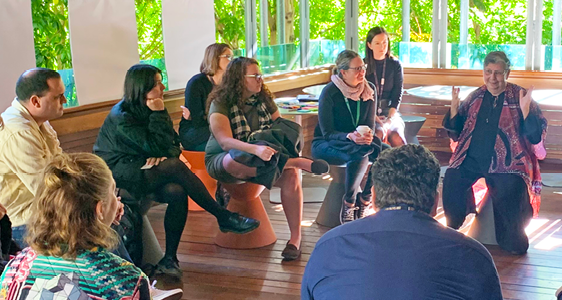
Research conducted within the Metro South Health region is involving the Indigenous community in projects that aim to improve their lives in areas such as cardiovascular disease, diabetes, drug and alcohol use, child health, incontinence, mental health and smoking.

Image used with permission of the Inala Indigenous Health Service – https://www.health.qld.gov.au/iihs


Case Study

First Nations Research in Primary Health Care – the Inala Way

Bena Brown

Research conducted within the Metro South Health region is involving the Indigenous community in projects that aim to improve their lives in areas such as cardiovascular disease, diabetes, drug and alcohol use, child health, incontinence, mental health and smoking.

Image used with permission of the Inala Indigenous Health Service – https://www.health.qld.gov.au/iihs


Acknowledgement of Country

We acknowledge the traditional custodians of the land we are on, and we recognise their continuing connection to land, waters and community. We pay deep respect to them and their cultures; and to Elders past, present and future.