Login
Contact

Explore

Explore

About
  • People and Partners
  • TRI Building
  • Reconciliation Action Plan
  • Strategic Plan
  • TRI Foundation
  • Careers
Research
  • Collaborate
  • Discovery
  • Translate
  • Engage
  • Research Areas
Clinical
  • Translational Trials
  • Clinical Research Facility
  • TRI at Children’s
Industry
  • TRI Incubator
  • The Precinct
  • Residents
Manufacture
  • New cGMP Facility
Facilities
  • Cleanroom
  • Flow Cytometry
  • Histology
  • Microscopy
  • Proteomics
  • Preclinical Imaging
  • Biological Research
  • Gnotobiotics
  • Human Immune Model
Get Involved
  • Health Consumers
  • SPARQ-ed
Resources
  • News
  • Events
  • Case Studies
  • Grants and Funding
  • Education and Training
+61 7 3443 7000info@tri.edu.au37 Kent Street, Woolloongabba QLD 4102 Australia

Acknowledgement of Country

TRI acknowledges the traditional custodians of the land we are on today, the Turrbal and Jagera people and we recognise their continuing connection to land, waters and community. We pay deep respect to them and their cultures; and to Elders past, present and emerging.

© Translational Research Institute Pty Ltd atf the Translational Research Institute Trust|ABN: 58 155 991 662
Privacy policy|Terms of Use|Contact Us
TRI · Facilities · Proteomics

Proteomics

OverviewEquipmentExpertiseVirtual Tour

Proteomics is the study of proteins in a system.

Modern proteomics techniques use high resolution accurate Mass Spectrometry to identify, quantify and characterise many thousands of proteins in a single experiment.

By using proteomics, we can gain significant insight into the biological function and biological changes associated with different disease or treatment conditions.

The TRI Proteomics core places significant focus on ensuring high quality and reproducible results. The team has extensive experience in project planning, sample preparation and analysis, instrument operation and data analysis.

Senior Proteomics Scientist
Dorothy (Dot) Loo-Oey
proteomics@tri.edu.au

Proteomics is the study of proteins in a system.

Modern proteomics techniques use high resolution accurate Mass Spectrometry to identify, quantify and characterise many thousands of proteins in a single experiment.

By using proteomics, we can gain significant insight into the biological function and biological changes associated with different disease or treatment conditions.

The TRI Proteomics core places significant focus on ensuring high quality and reproducible results. The team has extensive experience in project planning, sample preparation and analysis, instrument operation and data analysis.

Senior Proteomics Scientist
Dorothy (Dot) Loo-Oey
proteomics@tri.edu.au

Applications

TRI’s Proteomics Facility provides both full-service and self-service options as well as training and support.  Proteomics applications available at the TRI Proteomics facility:

  • Protein identification
  • Protein and analyte quantitation
  • Protein interaction assay
  • Multiplex (TMT) sample preparation and analysis
  • Phospho sample preparation and analysis

Capabilities

  • Mass spec analysis capabilities including Data independent analysis (DIA); Data dependent analysis (DDA); Parallel reaction monitoring (PRM)
  • Experiment design and project planning
  • Proteomics sample preparation
  • Mass spec sample analysis
  • Basic data and bioinformatic analysis
  • Access to facility resources including direct access to high-end instruments and data analysis software applications supported by high-capacity virtual machines to enable 24/7 user remote access to complex data analysis
  • Assay development, feasibility testing and method validation
  • High throughput workflows with robot liquid handling
  • Spatial omix analysis with newly acquired LMD7 laser microdissection microscope
  • Proteomics assay for clinical diagnosis of Amyloidosis subtype: Service provided in collaboration with the Pathology Queensland, Princess Alexander Hospital Amyloidosis Clinic (ISO 15189 accredited)
Training

Monthly comprehensive hands-on user training:

  • Proteomics Theory
  • Hands-On Laboratory training
  • Hands-On Data analysis training

Equipment

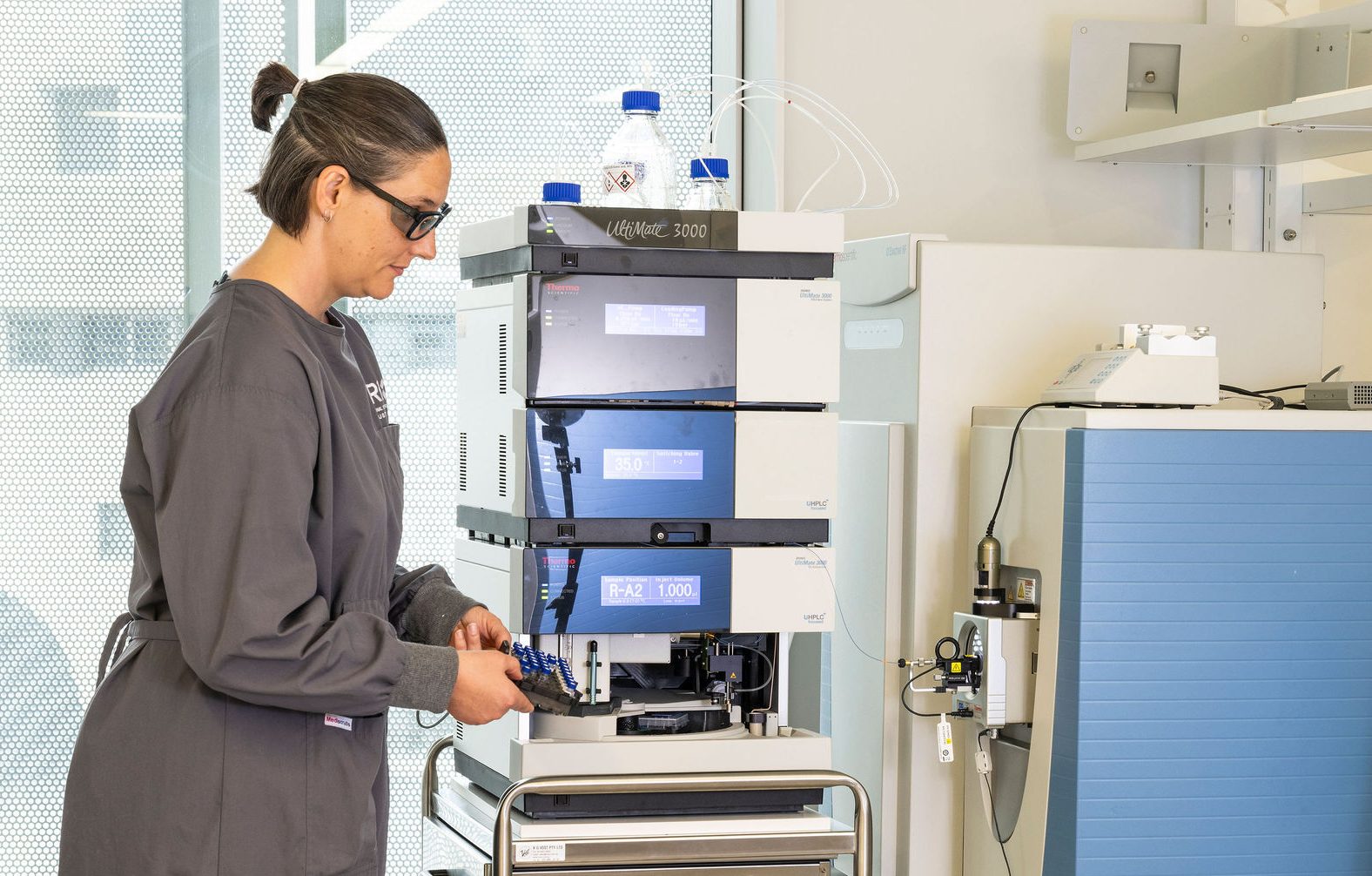
The Proteomics facility operation is largely reliant on two Q-Exactive Orbitrap Mass Spectrometers, with a selection of supporting instrumentation to assist in sample preparation.