Login
Contact

Explore

Explore

About
  • People and Partners
  • TRI Building
  • Reconciliation Action Plan
  • Strategic Plan
  • TRI Foundation
  • Careers
Research
  • Collaborate
  • Discovery
  • Translate
  • Engage
  • Research Areas
Clinical
  • Translational Trials
  • Clinical Research Facility
  • TRI at Children’s
Industry
  • TRI Incubator
  • The Precinct
  • Residents
Manufacture
  • New cGMP Facility
Facilities
  • Cleanroom
  • Flow Cytometry
  • Histology
  • Microscopy
  • Proteomics
  • Preclinical Imaging
  • Biological Research
  • Gnotobiotics
  • Human Immune Model
Get Involved
  • Health Consumers
  • SPARQ-ed
Resources
  • News
  • Events
  • Case Studies
  • Grants and Funding
  • Education and Training
+61 7 3443 7000info@tri.edu.au37 Kent Street, Woolloongabba QLD 4102 Australia

Acknowledgement of Country

TRI acknowledges the traditional custodians of the land we are on today, the Turrbal and Jagera people and we recognise their continuing connection to land, waters and community. We pay deep respect to them and their cultures; and to Elders past, present and emerging.

© Translational Research Institute Pty Ltd atf the Translational Research Institute Trust|ABN: 58 155 991 662
Privacy policy|Terms of Use|Contact Us
Back to equipment

Tissue Processor

The first choice in tissue processing now with advanced infiltration

The first choice in tissue processing now with advanced infiltration

A tissue processor machine is crucial in histology for preparing tissue samples for microscopic examination. It ensures samples are properly preserved, dehydrated, and infiltrated with paraffin – making them suitable for thin sectioning and detailed study under a microscope.

This instrument is full service only.
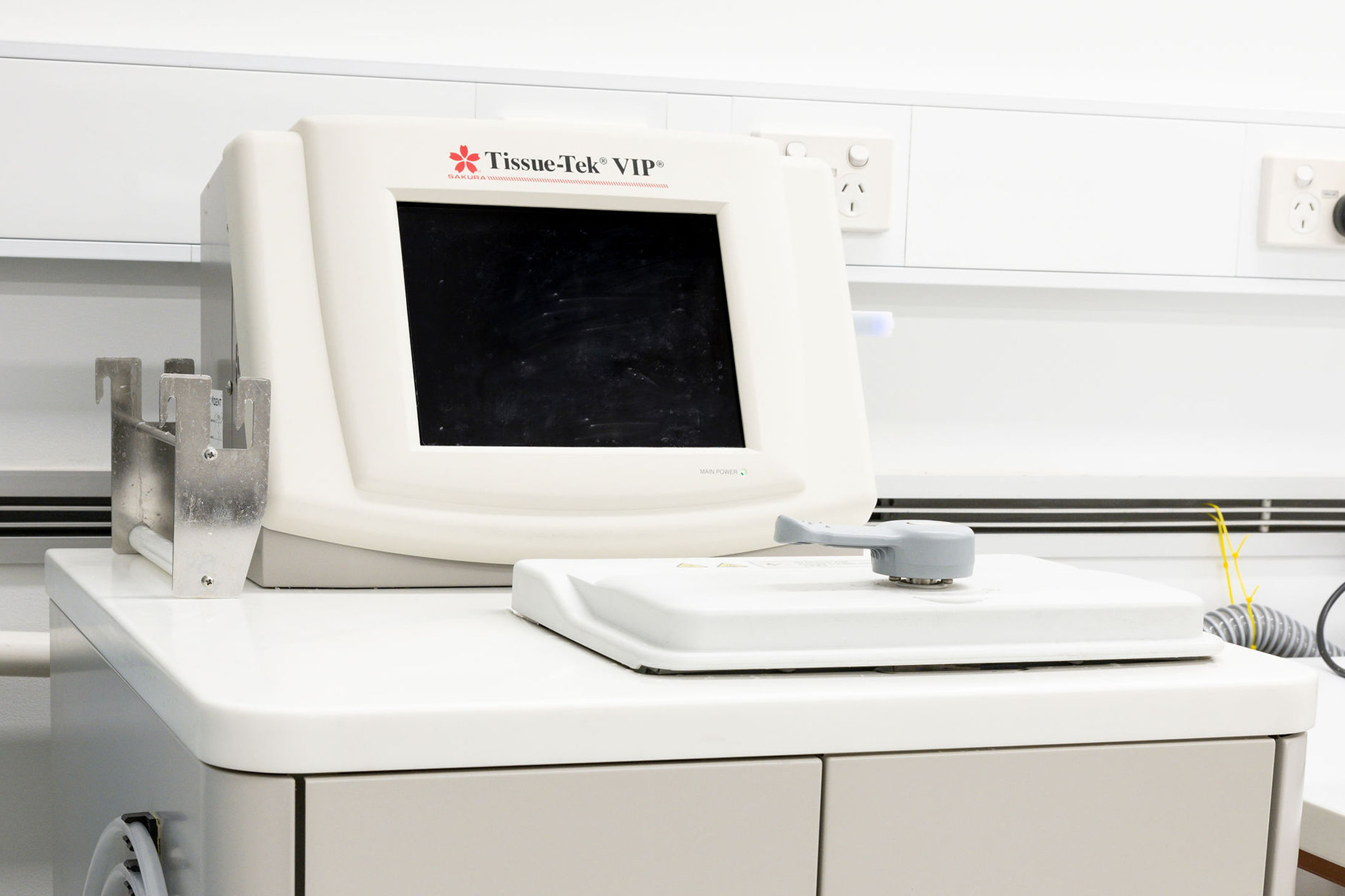
Features

  • Infiltrates tissue with paraffin wax to preserve tissue integrity and morphology.
  • Designed for the automated dehydration and paraffin infiltration of human, plant and animal tissues.
  • Fixed samples are submerged in a series of increasing concentrations of ethanol, then several changes of xylene, and finally infiltrated with paraffin prior to embedding.
  • Protocols can be customised to the sample’s needs with variable times, temperatures, and pressure and vacuum cycles.

Need more help?

For more information on instruments, services and facility charges contact the Histology Facility team.