Login
Contact

Explore

Explore

About
  • People and Partners
  • TRI Building
  • Reconciliation Action Plan
  • Strategic Plan
  • TRI Foundation
  • Careers
Research
  • Collaborate
  • Discovery
  • Translate
  • Engage
  • Research Areas
Clinical
  • Translational Trials
  • Clinical Research Facility
  • TRI at Children’s
Industry
  • TRI Incubator
  • The Precinct
  • Residents
Manufacture
  • New cGMP Facility
Facilities
  • Cleanroom
  • Flow Cytometry
  • Histology
  • Microscopy
  • Proteomics
  • Preclinical Imaging
  • Biological Research
  • Gnotobiotics
  • Human Immune Model
Get Involved
  • Health Consumers
  • SPARQ-ed
Resources
  • News
  • Events
  • Case Studies
  • Grants and Funding
  • Education and Training
+61 7 3443 7000info@tri.edu.au37 Kent Street, Woolloongabba QLD 4102 Australia

Acknowledgement of Country

TRI acknowledges the traditional custodians of the land we are on today, the Turrbal and Jagera people and we recognise their continuing connection to land, waters and community. We pay deep respect to them and their cultures; and to Elders past, present and emerging.

© Translational Research Institute Pty Ltd atf the Translational Research Institute Trust|ABN: 58 155 991 662
Privacy policy|Terms of Use|Contact Us
Back to equipment

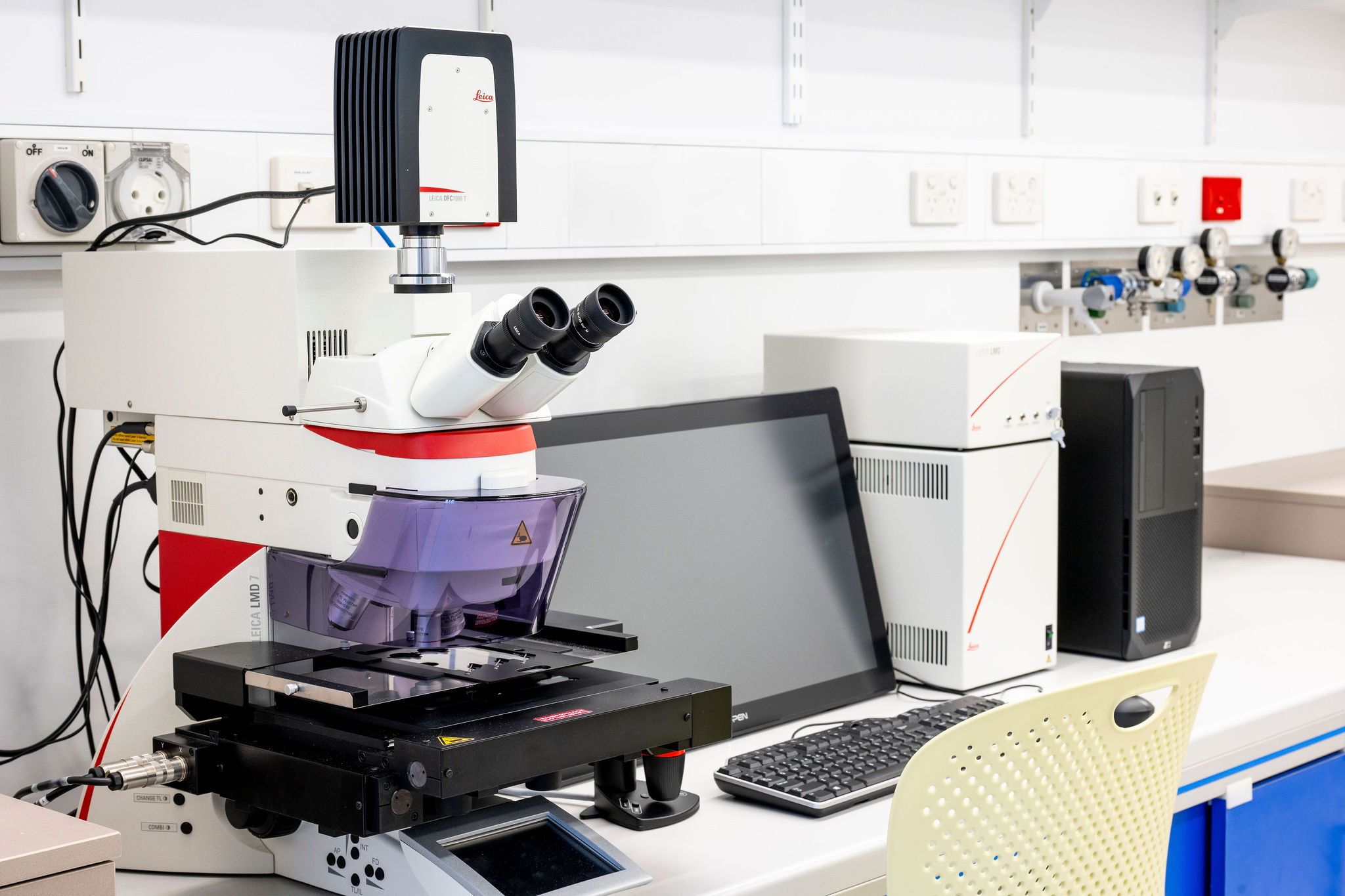
LMD7 Laser Microdissection

LMD7 Laser Microdissection Microscope

LMD7 Laser Microdissection Microscope

Laser Microdissection (LMD) enables users to isolate specific single cells or entire areas of tissue down to single cells or subcellular structures.

LMD is typically used in genomics (DNA), transcriptomics (mRNA, miRNA), proteomics, metabolomics, and even next generation sequencing (NGS). LMD is also useful for live cell culture (LCC), cloning and re-cultivation, manipulation or downstream analysis.
Features

This LMD instrument allows you to isolate specific regions of interest from complex samples such as tissue sections, providing pure samples for downstream analysis

Need more help?

For more information on instruments, services and facility charges contact the Proteomics Facility team.